Floating Bed Aesthetics: How Undermount Lighting Creates a Weightless Bedroom Vibe
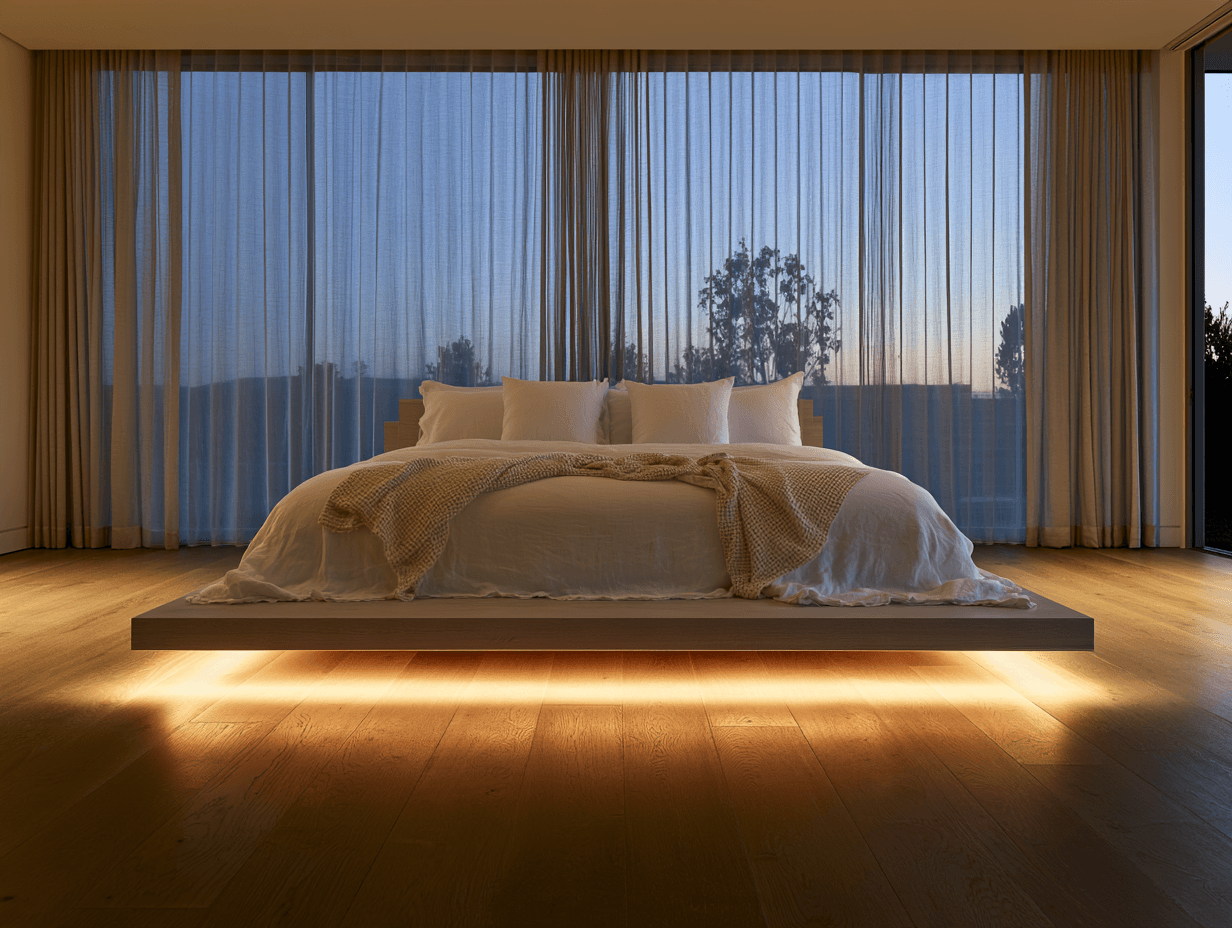
A floating bed with LED lighting creates its sense of weightlessness by pairing a recessed support base with carefully concealed light. The base falls into shadow, and the bed appears to hover just above the floor.
Symmetric Floating Bed Layouts
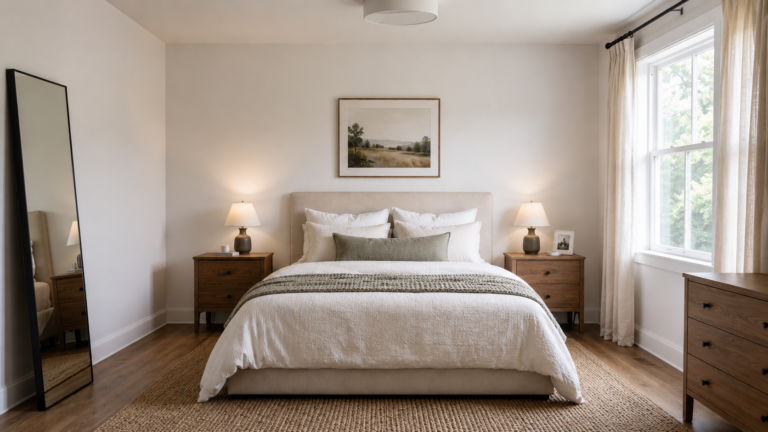
Undermount lighting works best in a room that is already balanced. A centered bed, matching nightstands and a pair of identical lamps give the glow a calm frame to sit inside. If one side looks heavier than the other, the light will expose it, and the whole floating bed design loses its lift.
Aim for roughly 24 to 30 inches (61 to 76 cm) of walking clearance on each side of the bed where the room allows. This gives the layout a comfortable feel and leaves enough open floor for the under-bed glow to remain visible. In a master bedroom, a wide rug that extends just past the frame will catch that glow and hold it. Keep the rug a quiet neutral, so the light rather than the pattern does the talking.
Symmetry also keeps the edit disciplined. Every object near the bed has to earn its place, because a floating frame leaves nowhere for clutter to hide. A pair of lamps, matching tables and one generous headboard wall are usually enough.
- Warm white light around 2700K keeps the glow soft and flattering.
- Recess the base so a shadow, not the frame, reads beneath the mattress.
- Mirror both sides of the room so the light falls evenly.
Creating the Illusion of a Recessed Bed Base

The illusion begins with the plinth. A floating bed frame sits on a base pulled several inches back from the platform edge, so the shadow beneath reads as open space. Finish that base in a deep matte tone and it nearly disappears, while a pale plinth gives the trick away.
Light is what makes the effect visible, and the strip itself should never be. Tuck the LED strip into an aluminum channel fitted with a frosted diffuser, and set it back from the front edge so no one sees it from standing height or across the room. The channel keeps the strip straight and helps carry heat away, while the diffuser blends the individual diodes into one clean line of glow along the floor.
Choose a UL-listed strip that is fully dimmable, because brightness control matters as much as color. Hardwiring gives the neatest finish, though a plug-in kit with the cable routed behind the headboard suits renters just as well. Keep the driver somewhere reachable, since it is the one part that may need attention later. A dimmer on the same circuit lets you lower the light as the evening settles in.
Low-Profile Beds and Open Sightlines
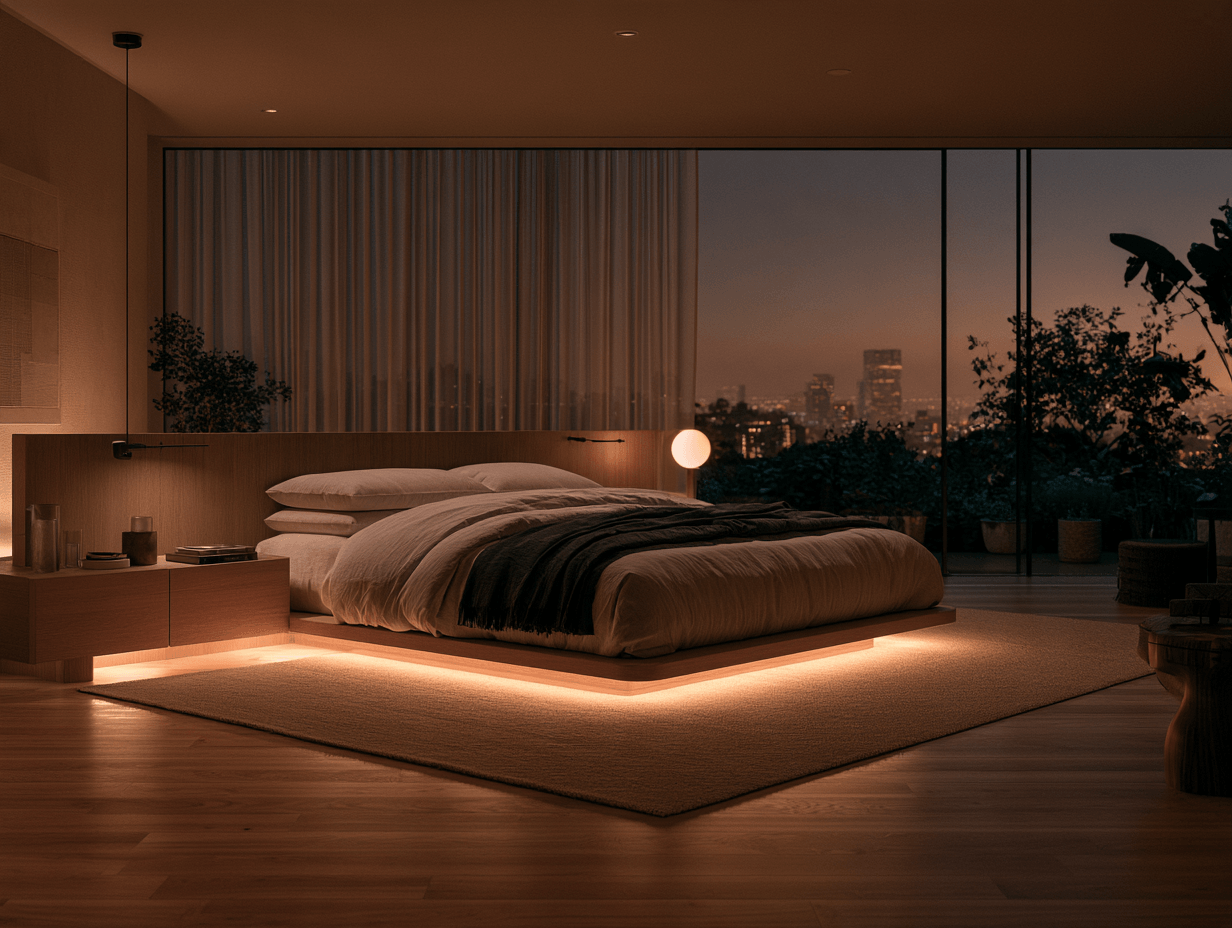
A low profile gives the bed a long, horizontal line, much like a building seen in elevation. Headboards that sit close to mattress height keep sightlines open across the room. On standard ceilings, that restraint stops the bed from feeling imposing.
At night, bedroom ambient lighting does its finest work. With the overheads off, the glow along the floor becomes the only light in the room, and furniture softens into silhouette. Add a dimmer and one warm bedside lamp, and the space settles into something close to candlelight.
This is where a low bed shows its range. By afternoon the frame reads as clean architecture, and after dark it becomes a soft, low horizon. Few pieces of furniture change character so completely from one hour to the next.
Textured Boucle Platform Frames

Softness is the counterweight to all that precision. A boucle platform bed wraps the frame in looped, nubby fabric that scatters light unevenly, so the glow beneath feels gentler. Concealed lighting suits the texture well, because the light grazes the underside and picks out each loop. Smooth lacquer throws light back in a hard line, while boucle lets it dissolve.
Keep the palette quiet with ivory, oatmeal and warm greige, and let one darker piece, such as a walnut nightstand, anchor the eye. If pets or children share the home, look for performance-grade boucle, which cleans far more easily than wool blends. Test a swatch under your actual bulbs before ordering, since warm light can push cream toward yellow.
Scale matters with a textured frame. A chunky weave suits a king bed in a generous room, while a tighter loop keeps a smaller bedroom from feeling upholstered to the walls. Either way, keep the base underneath smooth and dark, because a floating platform bed only works when the fabric appears to hover above it.
Fluted Wood Paneling and Floating Nightstands

Fluted wood adds rhythm without noise. The vertical grooves cast fine shadows that shift with the hour, and a fluted headboard running floor to ceiling makes a standard wall feel taller. Oak and walnut veneer in a matte oil finish keep the grain looking natural.
A floating nightstand carries the same linear idea. Mounted at mattress height, it clears the floor and keeps the lines continuous from headboard to bedside. Wall-mounted pieces should be fixed into studs or blocking, so plan their positions before the drywall closes.
A thin strip of light beneath each nightstand ties it to the bed. Treat the under-bed LED lighting and the nightstand strips as one system, with the same color temperature throughout, so the glows read as a single source. If the strips differ, even slightly, the room will look faintly mismatched even when nobody can say why. Buying them together from one product line is the easiest safeguard.
Warm Wabi-Sabi Minimalism

Japandi interiors pair Japanese restraint with Scandinavian warmth, and a low floating bed suits them well. The palette stays with clay, sand and soft charcoal, and nothing is there for show. In a Japandi bedroom, the light should feel closer to a paper lantern than a fixture.
Wabi-sabi, the Japanese way of finding beauty in what is imperfect and impermanent, adds the human hand. Linen softened by years of washing, a ceramic lamp with an uneven glaze, a single branch in a plain vessel: small irregularities keep a room from looking staged. None of it needs to match.
Keep the glow low and amber, and let it fall across natural materials such as oak, linen, plaster and clay. Their textures catch the light unevenly, so the shadows stay soft rather than sharp. The bed’s own shadow then becomes part of the composition, a quiet dark band between wood floor and pale linen.
A weightless bed is mostly a matter of shadow and light. Recess the base, keep the glow warm and low, and let texture and symmetry do the quiet work around it. That is most of what makes a floating bed work, and it asks for far less than it appears to.
Start with the lighting and live with it for a few evenings. Notice where the glow lands, and which corner of the room still feels heavy. You will know soon enough what the room wants next.
Floating Bed with LED Lighting — Common Questions
How much floor should show beneath a floating bed?
The visible gap varies by bed design, platform thickness, and the depth of the recessed support base. Many floating-style beds use a set-back plinth to create a clear shadow line, while integrated LED lighting makes that gap more noticeable. Check the manufacturer’s specifications rather than relying on one standard measurement.
What color temperature is best for under-bed lighting?
Warm white between 2700K and 3000K suits a bedroom best. It reads like candlelight and keeps wood, linen and boucle looking rich. Cool white tends to feel clinical in a room meant for rest.
Can I install undermount LED lighting myself?
Plug-in kits are a reasonable weekend project, as long as the strip and driver are UL-listed. Hardwired setups connect to your home’s electrical system, so they are best left to a licensed electrician. Local building codes may also apply, particularly for new construction.
Will under-bed lighting disturb my sleep?
Under-bed lighting is less likely to feel disruptive when it is dim, indirect, and used only when needed. Choose a warm color temperature, keep brightness low, and consider a motion sensor for nighttime movement. Individual sensitivity to light varies, so avoid leaving bright LEDs on throughout the night if they affect your comfort.